
CNTO London Visits Newcastle for Cultural and Tourism Exchange, Exploring Beiyang Fleet Heritage to Boost Practical Sino-British Cooperation
From 27 to 28 May, a delegation led by Zhang Li, Director of the China National Tourist Office (CNTO) London, and Pan Hang, Assistant Director of CNTO London, visited Newcastle upon Tyne, UK. The delegation met with local cultural and museum institutions, tourism authorities, and historical heritage conservation organisations.
They engaged in face-to-face discussions focusing on the protection and utilisation of the Beiyang Fleet’s overseas relics, the alignment of Sino-British cultural and tourism resources, the joint curation of museum exhibitions, and the two-way exchange of tourism markets. Relying on the profound historical ties between the two regions, the visit aimed to deepen and solidify cultural and tourism cooperation between the North East of England and China.
Newcastle shares a deep modern historical connection with China. In the late 19th century, the Qing government dispatched Beiyang Fleet admirals, including Ding Ruchang and Deng Shichang, in 1881 and 1887 to lead delegations to the Armstrong Shipyard in Newcastle to take delivery of four cruisers: Chaoyong, Yangwei, Zhiyuan, and Jingyuan. The voyage to receive these vessels was long and arduous, and six Chinese sailors tragically died in a foreign land, ultimately being laid to rest in the local St John’s Cemetery. During the First Sino-Japanese War, all four warships were sunk in battle. Deng Shichang, Ding Ruchang, and other officers and men of the Beiyang Fleet died for their country, writing a heroic and solemn page in the history of the Chinese nation.
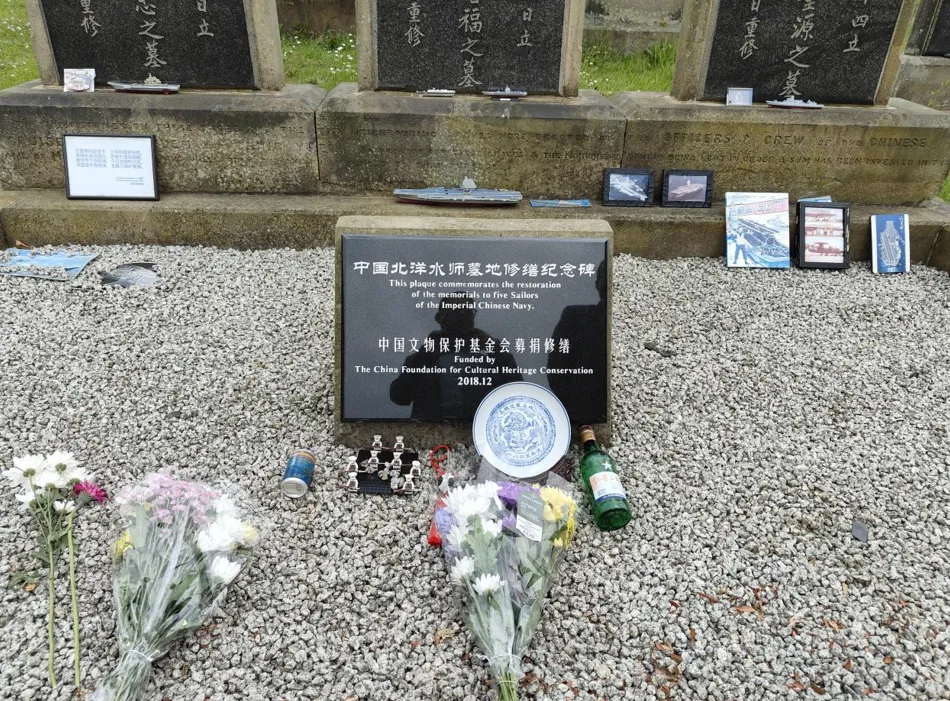
In 2016, the UK Beiyang Fleet Heritage Conservation Foundation collaborated with the China Foundation for Cultural Heritage Conservation to restore the original five tombstones. In 2024, a sixth tombstone was discovered in the cemetery. During the Qingming Festival or the anniversary of the Battle of the Yalu River, overseas Chinese and Chinese students in the UK consistently lay flowers at the graves, or place photographs and models of the latest Chinese naval vessels, to express their grief for the martyrs of the Beiyang Navy and their hope for a stronger Chinese navy.

On the afternoon of 27 May, Zhang Li and his delegation first visited St John’s Cemetery in Newcastle to solemnly pay their respects at the tombs of the Beiyang Fleet sailors and conduct an on-site inspection of the current state of heritage conservation and the foundational conditions for cultural and tourism development.
During a discussion with Qi Yongqiang, President of the UK Beiyang Fleet Heritage Conservation Foundation, Zhang Li stated that the Beiyang Fleet sailors’ tombs are a precious and vital China-related historical tourism resource in the UK. They carry a unique memory of modern naval history and national spirit, possessing outstanding historical, cultural, patriotic education, and tourism value. All parties should adhere to the principle of prioritising protection alongside orderly development, carefully safeguarding this overseas cultural heritage, and effectively telling the stories of the Beiyang Fleet martyrs.
This historical connection, spanning over a century, can serve as a vital bond for enhancing mutual understanding between the British and Chinese peoples.

Subsequently, the CNTO London delegation visited museum authorities in the North East of England, holding a working meeting with Museum Director Keith Merrin and Head of Programmes and Collections Bill Griffiths FSA (Fellow of the Society of Antiquaries).
Keith Merrin noted that earlier this year, he visited China with a delegation led by British Prime Minister Keir Starmer. He witnessed first-hand the vigorous development of China’s cultural, museum, and tourism industries, and was deeply impressed by China’s advanced experiences in museum construction and the revitalisation of cultural relics. He expressed his anticipation for establishing a regular exchange mechanism with the Chinese side to mutually share experiences in the development of the museum sector.
Bill Griffiths explained that the North East England museum collections house a wealth of precious artefacts, including first-hand written records and photographs from the time the Beiyang Fleet officers and men visited Newcastle. These materials provide a complete and authentic record of local residents welcoming the Chinese sailors and the early non-governmental exchanges between Britain and China. Noting that these artefacts possess immense historical value and enormous potential for cultural tourism development, he expressed a desire to utilise these unique collections to jointly launch cooperative projects with China, such as thematic exhibitions and historical and cultural seminars.
Zhang Li pointed out that the historical relics related to the Beiyang Fleet are a shared historical wealth of both China and the UK. Strengthening cooperation in the museum sector uses history as a link to bring the people of the two countries closer together. CNTO London will actively build communication platforms to assist museums on both sides in deepening practical cooperation, promoting century-old historical artefacts to emerge from storerooms, and ensuring that this previously overlooked history of Sino-British interaction becomes known to a wider public.

During the meeting, both parties also visited the Discovery Museum together to inspect the proposed site for a commemorative thematic exhibition marking the 140th anniversary of the completion of the Zhiyuan and Jingyuan warships.
On 28 May, Zhang Li and his delegation visited the North East England tourist board, holding a meeting with its Chief Operating Officer, Ian Thomas, and Chris Fraser OBE (Officer of the Order of the British Empire), former Operations Director of the Northern Way.
Ian Thomas detailed the advantages of the cultural and tourism resources in the North East of England. The tourist board is responsible for promoting tourism across seven cities, including Newcastle, Sunderland, and Durham. The region boasts rich tourism resources, such as two UNESCO World Heritage Sites (Hadrian’s Wall and Durham Cathedral), the highest concentration of castles in the UK, and over 70 international cruise routes.
It is also home to the UK’s third-largest Chinatown and the Beiyang Fleet tombs, representing significant cultural tourism resources closely connected to China. He expressed a keen anticipation to attract more Chinese tourists to the Newcastle region.
Zhang Li stated that the North East of England possesses outstanding tourism resources, and the Beiyang Fleet sailors’ tombs are a unique historical and cultural bond between China and the UK. The Chinese side is willing to deepen comprehensive cultural and tourism cooperation with the North East England tourism authorities, promoting exchanges among tourism professionals and the two-way flow of tourists, using cultural and tourism exchanges to help non-governmental friendly relations between China and Britain continue to flourish.

This visit to Newcastle has further opened communication channels between CNTO London and the cultural, museum, and local tourism authorities in the North East of the UK. It has established three major directions for future cooperation: protection of historical heritage, joint curation of thematic exhibitions and mutual promotion of tourism markets.
Moving forward, CNTO London will continue to rely on overseas China-related historical and cultural resources to build more bridges for Sino-British tourism communication, driving cultural and tourism cooperation between the two nations deeper and making it more impactful.